
Social media has become an important part of how businesses communicate with customers. Companies use platforms such as Instagram, Facebook, LinkedIn and WhatsApp to showcase products, answer questions and promote their services.
For many small businesses, these platforms provide an accessible way to establish an online presence.
However, as a business grows, relying entirely on social media can create limitations. Important information may be scattered across posts and conversations. Customers may struggle to find service details, compare offerings or submit structured enquiries. The business may also have limited control over how its information is presented.
A professional business website provides a more organised digital foundation.
For Nigerian businesses looking to attract customers, build credibility and generate enquiries, understanding the role of a website is an important part of digital growth.
What Does a Business Website Actually Do?
A business website is more than an online brochure. It can serve as a central point where prospective customers learn about your organisation, understand your services and decide what to do next.
Depending on its purpose, a website may include:
- Information about the business and its team.
- Service descriptions and pricing information, where appropriate.
- Product catalogues or property listings.
- Portfolio examples and case studies.
- Contact forms and enquiry management.
- Appointment booking or registration.
- Online payments and e-commerce.
- Customer portals or links to specialised business systems.
The right structure depends on what the organisation wants its website to achieve.
A consulting firm may prioritise service pages and consultation enquiries. A real estate agency may need property listings and lead capture. An online retailer may require product pages, a shopping cart and checkout functionality.
The objective should guide the design.
Five Reasons to Invest in a Professional Website
1. Build a More Credible Online Presence
Potential customers often research a business before making contact.
A well-organised website can provide clear information about the company's services, location, contact details, experience and working process.
It also gives the business control over its presentation, navigation and messaging.
A website does not automatically guarantee trust. Its information should be accurate, its design should be usable, and its claims should be supported by genuine evidence.
2. Help Customers Discover Your Services Through Search Engines
People regularly use search engines to find products, service providers and solutions to specific problems.
A properly structured website creates opportunities for relevant pages to appear in search results.
For example, a healthcare provider may want to be discovered by people searching for its services in a particular location. A school may need pages explaining its programmes and admission process. A software company may publish helpful articles about the business problems its products solve.
Search engine optimisation (SEO) helps improve how search engines understand and present a website.
Important elements include useful content, descriptive page titles, relevant headings, sensible internal links, mobile usability and technically accessible pages.
SEO takes time and does not guarantee particular rankings or traffic levels. Its effectiveness depends on competition, content quality, technical factors and other signals.
3. Generate More Structured Enquiries
A website should make it easy for interested visitors to take the next step.
Depending on the business, that step might be requesting a quotation, booking a consultation, asking about a property, scheduling an appointment or requesting a product demonstration.
Contact forms can collect relevant information before a staff member responds. Clear calls to action help visitors understand what to do next.
Businesses can also connect enquiry forms to appropriate notification or customer management workflows, where supported.
The important point is to make the journey from interest to enquiry straightforward.
4. Present Your Products and Services Clearly
Social media posts are useful for updates and engagement, but older posts can become difficult to find.
A website can organise information into dedicated pages, categories and navigation menus.
Customers can review the information most relevant to them without scrolling through unrelated updates.
For businesses with multiple services, product lines or locations, this structure can make the online experience easier to understand.
5. Build a Foundation for Future Digital Services
A business website can be the starting point for broader digital transformation.
As requirements evolve, the organisation may introduce online payments, customer accounts, booking tools, product management, a marketplace or integration with internal business software.
Not every website requires these features from the beginning. A phased approach can help businesses start with essential functionality and expand when there is a clear need.
Website, Social Media or Both?
These channels serve different purposes, and businesses generally benefit from using them together.
Social media helps with engagement, community building, announcements, content distribution and conversations with prospective customers.
A business website provides a structured destination for service information, search visibility, enquiries and specialised digital functions.
A practical strategy is to use social media to attract attention and direct interested people to relevant website pages. The website then helps visitors understand the offer and take the next step.
For example, a real estate company could publish a property highlight on social media and link to the complete listing on its website. A school could promote admissions and direct parents to a page explaining programmes and application requirements.
This creates a clearer journey from discovery to action.
What Type of Website Does Your Business Need?
The answer depends on your objectives.
- Corporate website: Suitable for businesses that need to explain their services, showcase their work and receive enquiries.
- E-commerce website: Designed for businesses selling products online, with relevant catalogue, cart, checkout and order management features.
- Real estate website: Can organise property listings, search filters, enquiries and other agency-specific functions.
- Hospital or clinic website: Can present medical services, facility information, contact details and appointment options where available.
- School website: Can communicate programmes, admissions, school information and relevant parent enquiries.
- Custom web application: Appropriate when the business needs more specialised workflows, dashboards, user accounts or integrated processes beyond a conventional website.
A business should not pay for complex functionality simply because it is available. Start with the problem the website must solve.
What Should You Look for When Hiring a Website Developer?
Choosing a developer involves more than comparing prices.
Understand the Scope
Ask which pages, features and integrations are included. Clarify whether content entry, mobile optimisation, contact forms and basic technical SEO are part of the project.
Check the Portfolio
Review previous projects where possible. Look at the mobile experience, navigation, loading behaviour and relevance to the type of website you need.
Discuss Ownership and Access
Clarify who controls the domain, hosting account, website administration and any applicable licences. Make sure the handover arrangements are clear.
Plan for Maintenance
Websites require updates, security monitoring, backups and occasional technical improvements. Discuss who will handle these responsibilities and what ongoing costs may apply.
Ask How Success Will Be Measured
Depending on your objectives, useful measures may include relevant website visits, enquiry submissions, appointment requests, sales or other meaningful conversions.
Analytics and tracking should be configured appropriately, with consideration for privacy and applicable requirements.
How Much Should a Business Website Cost in Nigeria?
There is no universal price for website development.
Costs depend on the number of pages, design requirements, content preparation, integrations, e-commerce features, custom functionality and ongoing services.
A simple informational website generally involves a different scope from a large online store or custom web application.
When comparing proposals, look beyond the headline price. Confirm the included features, domain and hosting arrangements, security setup, training, maintenance and future development costs.
A clear written scope helps both parties understand what will be delivered.
Common Website Mistakes to Avoid
Some businesses invest in websites that look attractive but do little to support their objectives.
Common problems include:
- Unclear service descriptions.
- Missing or outdated contact information.
- Poor mobile usability.
- Slow-loading pages.
- Confusing navigation.
- Broken enquiry forms.
- No clear next step for visitors.
- Publishing content without considering what customers need to know.
- Neglecting updates and security.
A useful website should combine clear communication, practical functionality and ongoing care.
How Abexi Digital Technologies Can Help
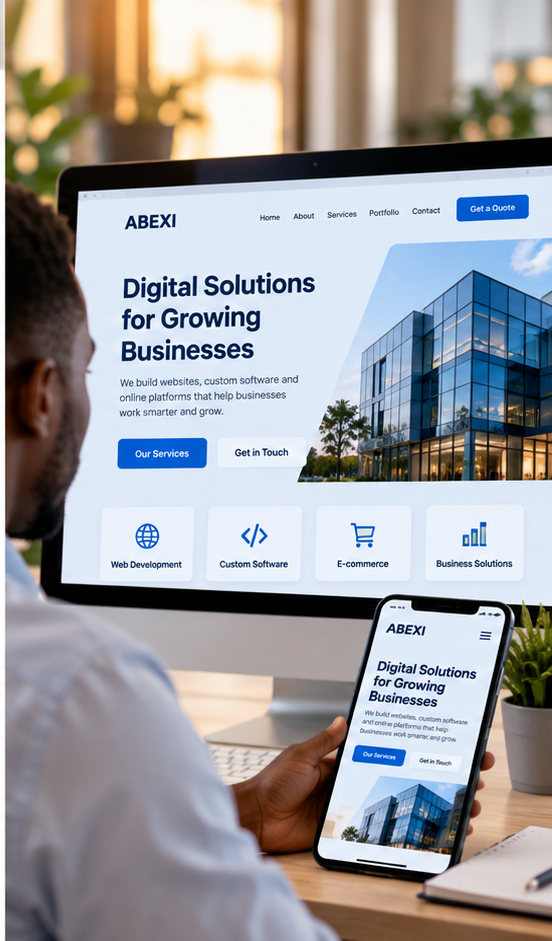
Abexi Digital Technologies provides professional website development, e-commerce solutions, custom web applications and digital services for businesses and organisations.
We work with clients to understand their goals and identify a suitable approach, whether they need a company website, an online marketplace, a specialised platform or a broader digital solution.
Our focus is on building around the client's requirements rather than treating every business as if it needs the same product.
The right starting point is a conversation about your services, target customers and desired outcomes.
Conclusion
A professional website gives your business a structured online presence and creates opportunities to present services clearly, support search visibility and generate enquiries.
It does not replace social media, customer service or a sound business strategy. Instead, it can complement these activities and provide a foundation for future digital services.
For a growing Nigerian business, the question is not simply whether to have a website. It is what the website should accomplish and how it will support the organisation's goals.
Ready to establish or improve your business website? Contact Abexi Digital Technologies to discuss a solution tailored to your needs.
Visit Abexi Digital Technologies to explore our services.